Five people. One camper.
Two films. One decision that changed everything.
Timo & Salima — and three daughters.
The first crawl I missed.
In 2016 I was self-employed. Clients, deadlines, long days. Salima was pregnant. I came home at night and had nothing left. Physically there, but not really present.
Then our first daughter arrived. And I was often missing. Her first crawl — I missed it. Her first laugh — Salima told me about it. Her first steps — I was at work.
One evening I sat down and finally understood: I was building gardens for other people while watching my own child grow up through other people's messages. That feeling never left.
"We didn't leave against anything. We left for something."
Salima and I talked for a long time. Not one night — many. And then we made a decision. Not against something. For something. For time. For our daughter. For us.
We sold everything. The business, the furniture, most of what we owned. No plan, no script, no concept. Just one question in our heads: What happens when you give your family the most valuable thing there is — time together?
What came next, we couldn't have invented.
Three years in Asia. And an island that wouldn't let us go.
Our first family trip took us through Asia. Thailand, Cambodia, Malaysia — travelling slowly, no deadlines, no return ticket. Our daughter learned to walk while we were on the road. This time I was there to see it.
Then Sri Lanka. And Sri Lanka didn't let go. A few weeks turned into almost two years. For three months we helped out on a coconut plantation. Real work, callused hands, lunch with the families there. Not a tourist backdrop — everyday life. Encounters that still shape us today.
I always had the camera with me. Not for a film. It was our diary. Capturing moments that would otherwise vanish — that was all.
Toward the end of the trip, our second daughter was born. On Bali. Two children, born in two worlds.
When we got back to Germany, friends saw the footage and said: you have to show this. We laughed. A film in cinemas? Us? They were right.
On the Way — When Encounters Change Everything
Three years of personal diary became our first theatrical film. No staging, no script — just what actually happened. The plantation. The people. A family finding itself on the road. The film ran in cinemas across Germany. People sat in the dark and cried, laughed, and wrote to us afterwards: you started something in me.
Trapped in India. With a newborn.
After the success of our first film it was clear: our second daughter deserved this experience too. So we set off again. Another long journey as a family.
Along the way, Salima became pregnant. Our third daughter was born in India. And then something happened that we wouldn't wish on anyone: the authorities didn't believe the baby was ours. The accusation: surrogacy.
For ten months we weren't allowed to leave India. Ten months of uncertainty. With a newborn and two small children. Government offices, waiting rooms, paperwork, hope, setbacks.
We could have broken under that. We didn't. What we learned during that time was what actually holds a family together — not the circumstances, but the connection between you. And yes — the camera kept rolling. Not for a film. Because filming had long become the way we make sense of life.
Those ten months became our second theatrical film.
"Sometimes life writes the film. Not you."
The Long Way Around
Sometimes the detour is the real road. The Long Way Around tells the story of those ten months in India — a family held in place that somehow becomes freer than ever before. Not a travel film with sunsets. A film about trust, patience, and what remains when every plan falls apart. It also ran in cinemas across Germany.
Cinema Release · Germany 2022 & 2024
Two films. Both in regular cinema release.
Not streaming exclusives. Not festival-only. Both films had full theatrical releases — booked by cinema programmers, watched by paying audiences across Germany, Austria and Switzerland.
"A warm-hearted plea for humanity, tolerance and international understanding."
Schwäbisches Tageblatt
"… a tribute to freedom of speech, hospitality and openness to the world …"
epd Film
"Overwhelming impressions, encounters and adventures …"
Rheinpfalz.de
As covered by German national television and press






The education app that taught us something else entirely.
Back in Germany, everyday life kicked back in. And with it, the screens. We'd downloaded an educational app for the kids. Looked professional, great reviews, solid pedagogical concept.
Then I actually watched my daughter use it. She was racing through the lessons. Not to learn — to get to the reward game faster. Tap, tap, tap, reward.
"Screens don't lose to bans. They lose to real life."
It hit me: even the good apps run on the same addiction model as social media. Points, rewards, dopamine. The learning is the barrier, not the goal.
What actually worked, we only understood on the road: screens don't lose to bans. They lose to real life. On the journey, the devices became uninteresting all on their own. No more arguments. No more fights.
How that happened — and what you can do at home without a camper or a world trip — we wrote it all down.
How we cut screen time — the full story →Three daughters. One camper. Heading for China.
Our youngest is old enough now. And for the first time, all three sisters can share this experience together. That was the moment for us: not two kids with travel memories and one without — but three sisters discovering the world side by side.
Because here's something nobody told us beforehand: on a journey like this, siblings actually learn how to be together. Not sitting next to each other in front of screens — with each other. Arguing, making up, being in awe together. That bond stays with them for life.
"On a journey like this, siblings learn how to actually be together. That bond stays for life."
Starting spring 2027, we'll drive our camper from Germany toward China. The girls will learn on the road — roadschooling. Maths at the kitchen table in the camper, geography through the window, languages in the marketplace. The world will be their classroom.
And of course the camera will be rolling. The third film comes to life once the journey begins.
Two films tell how it all began. The third is in the works.
On the Way – When Encounters Change Everything
128 minutes. A journey that shows what happens when you truly listen.
The Long Way Around
118 minutes. India. Ten months on film. The most honest film we've ever made.
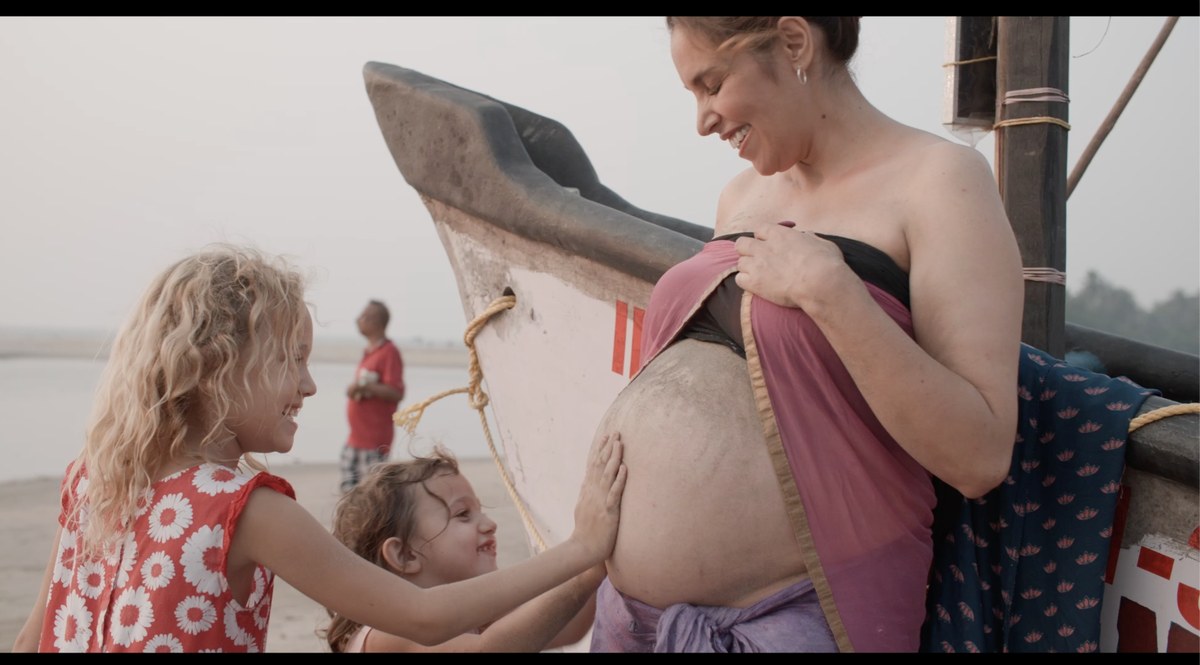
Goa, India. Two weeks before our third daughter was born. The girls had been talking to her through Salima's belly for months. This was the day they felt her kick back.
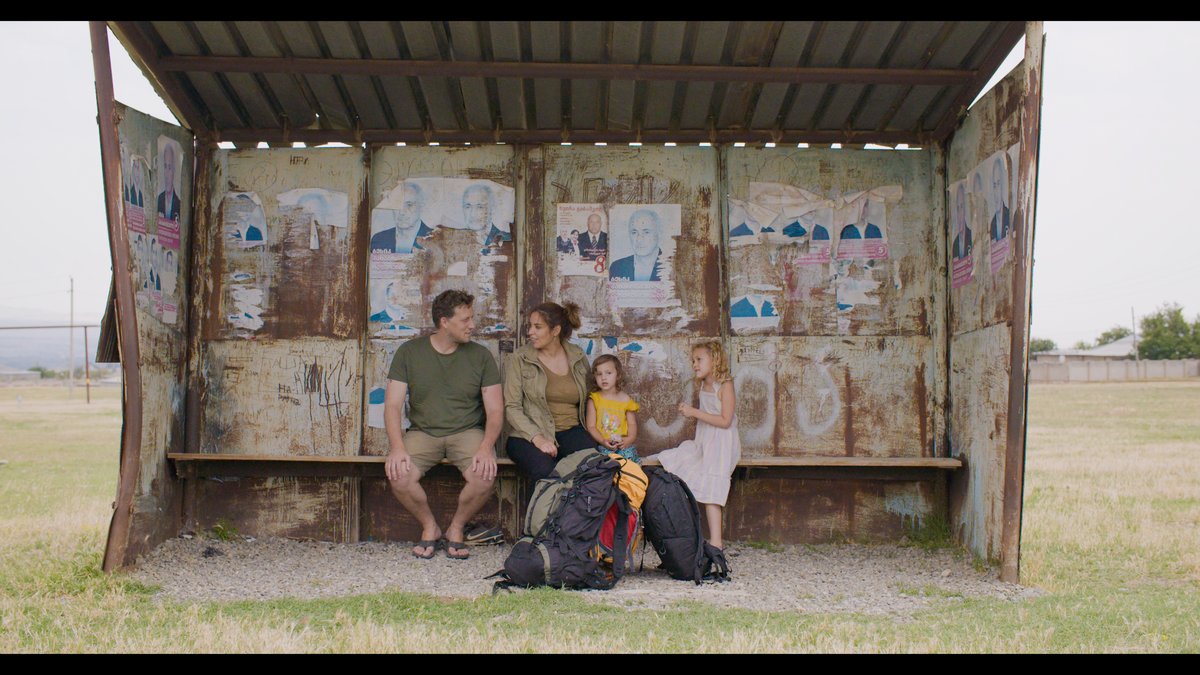
A bus stop in Georgia. Backpacks on the ground, nowhere to be, no schedule to keep. The girls thought it was perfectly normal. Maybe it is.