Worldschooling & Roadschooling:
Learning on the Road with Three Kids.
Three daughters. 22 countries. What it actually looks like when children learn from the world.
The world as a classroom — taken literally.
Roadschooling — or worldschooling, as many travelling families call it — means children learn on the road, with books in the bag and the world as an additional teacher. Real experiences, encounters, and situations complement what no timetable can plan for.
Maths during the journey. Geography through what they see every day. History in real ruins, not textbooks. Biology in the desert, on the Atlantic coast, in the rainforest.
We've been worldschooling since 2016. Two journeys, 22 countries, three daughters (now 10, 6, and 3). What we've learned about learning itself in that time — is more than we ever expected.
Structure in the morning. World in the afternoon.
We tried unschooling for a while. Pure freedom, zero structure. It didn't work for us — or rather, it worked for the three-year-old and nobody else. The older two needed something to push against.
What actually works: mornings are for focused work. Emilia does maths and German writing — around 90 minutes, always the same time, always at the fold-out table in the van. Elina practises reading with Salima. When the 90 minutes are done, they're done. No extending, no adding on.
The afternoons belong to wherever we are. A market in Dakar. A Roman amphitheatre in Georgia. A family in a yurt in Kazakhstan who invited us in for tea and kept us for three hours. That's when the real learning happens — and children know the difference. They show up fully because nobody forced them to.
We don't follow a curriculum. We follow the route. The curriculum adjusts.
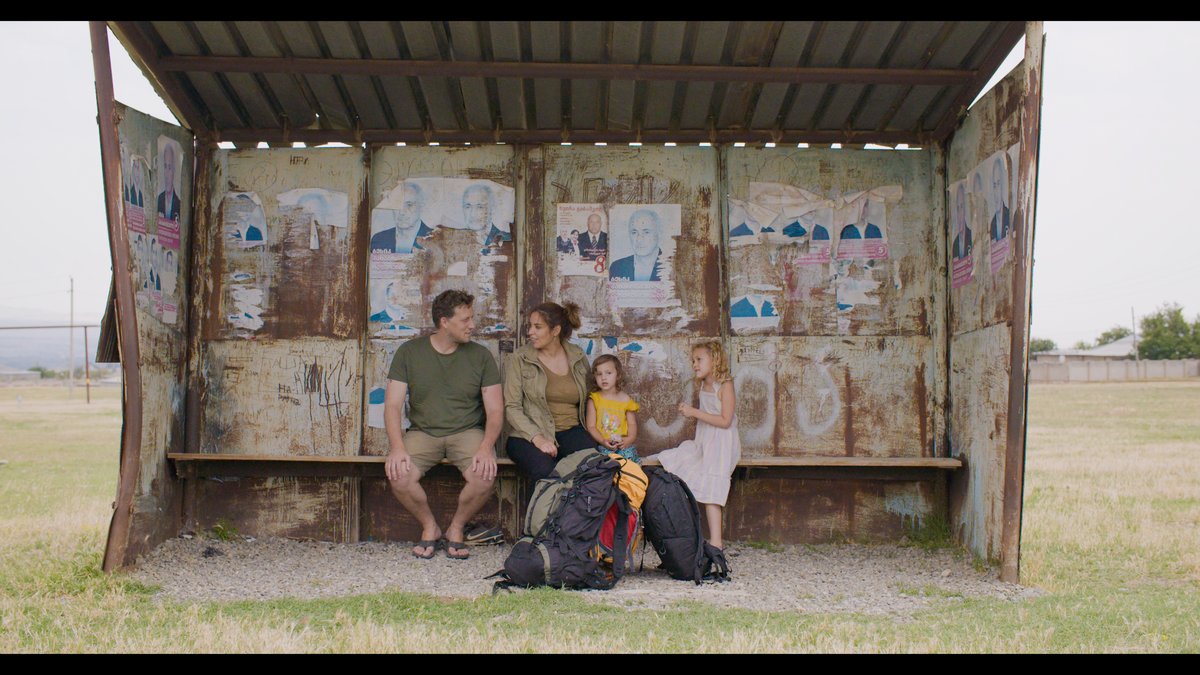
A bus stop in Georgia. Nobody planned this lesson.
The lessons that aren't on any timetable.
The van broke down outside a village in eastern Georgia. We waited four hours at a bus stop while a mechanic was called. By the second hour, Emilia was trading half a chocolate bar for the local kids to teach her how to count to ten in Georgian. By the fourth, she knew the words for "thank you," "fast," and "broken."
Learning on the road looks like that. Not a worksheet. Not an app. A bus stop, a broken van, and a kid who suddenly needs the language to be understood.
Last week Elina asked why the moon was orange that night. We didn't know. We drove to the next town with internet and read about dust in the atmosphere for an hour. That's the curriculum now — whatever the road asks of us.
Follow Our Journey →Languages
Our daughters learned English on the street. Spanish from market vendors. Arabic from Salima's family. No curriculum — just real conversations.
Geography & History
When you're driving through the Caucasus and someone asks "Where are we?" — that's geography. When you stand in Persepolis — that's history. No child forgets that.
Social Learning
Three siblings in a small space learn to actually be together. That is the most valuable lesson — and the one no timetable can teach.
The lesson is the person standing in front of you.
We were leaving a small village in Rajasthan. A woman we had spent two afternoons with — drinking chai, watching her cook, not sharing a single word of any common language — opened her arms. Elina ran into them without thinking.
That's experiential learning. Not the textbook kind. The kind where a six-year-old understands, in her body, that a stranger in a sari in a village she'll never see again can love her. Real world education writes itself into the nervous system. It doesn't fade.
Every worldschooling family we know has stories like this. A grandmother in Senegal who taught Emilia to braid hair. A truck driver in Kazakhstan who shared his lunch with us on the side of the road. These are not anecdotes. These are the curriculum.
We didn't teach her any of that. The people did.
Get the Guide — $14.90 →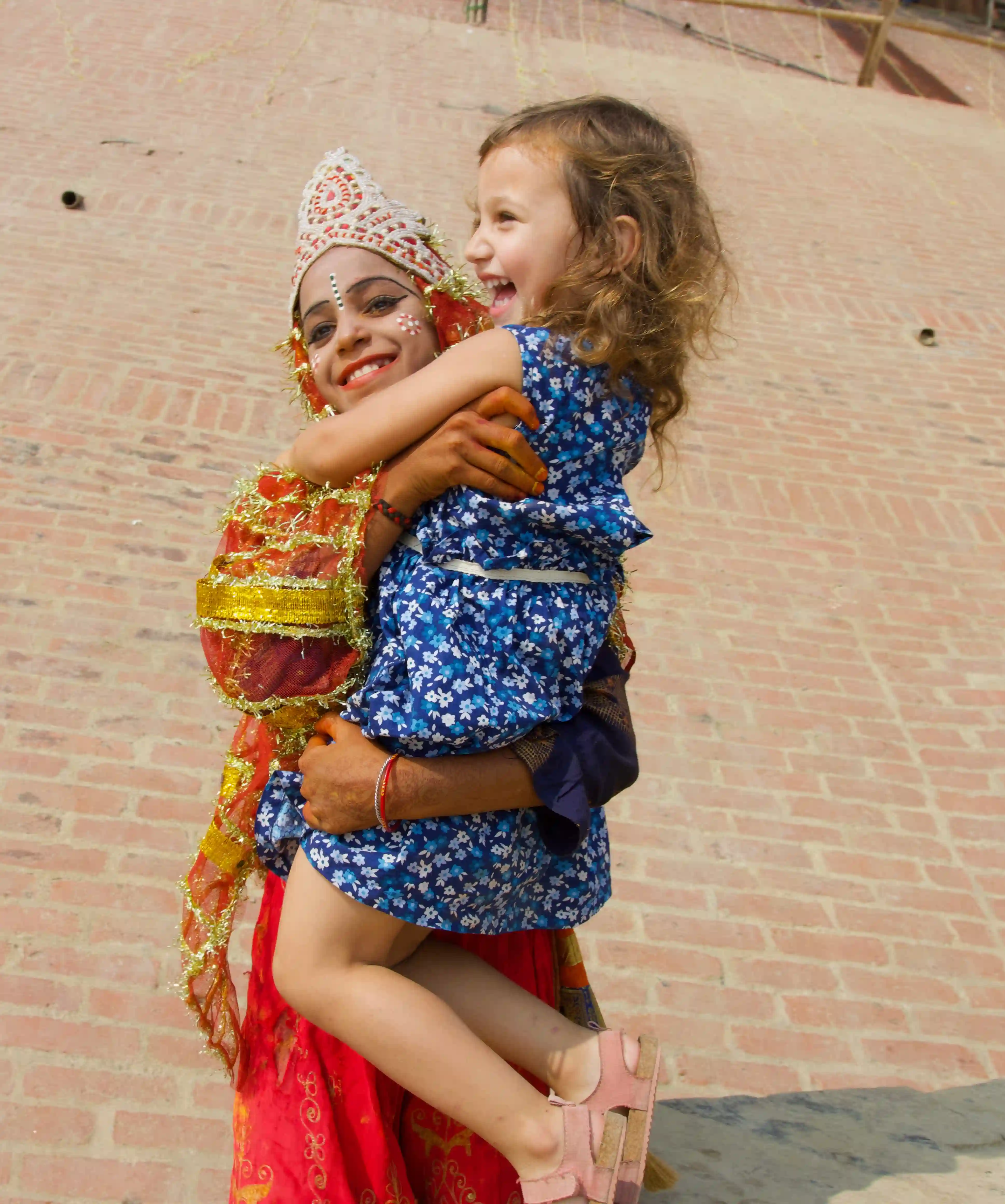
Saying goodbye in Rajasthan. The lesson nobody planned.
Emilia walked into that school not knowing a single word of Hindi.
No tourist programme. No international school. A real village school — real uniforms, real timetables, real kids who had never seen a blonde girl before.
After two weeks she had a best friend. After four weeks she was following the lessons. She picked up Hindi the way children pick up languages — by actually needing it.
We didn't teach her that. India did.
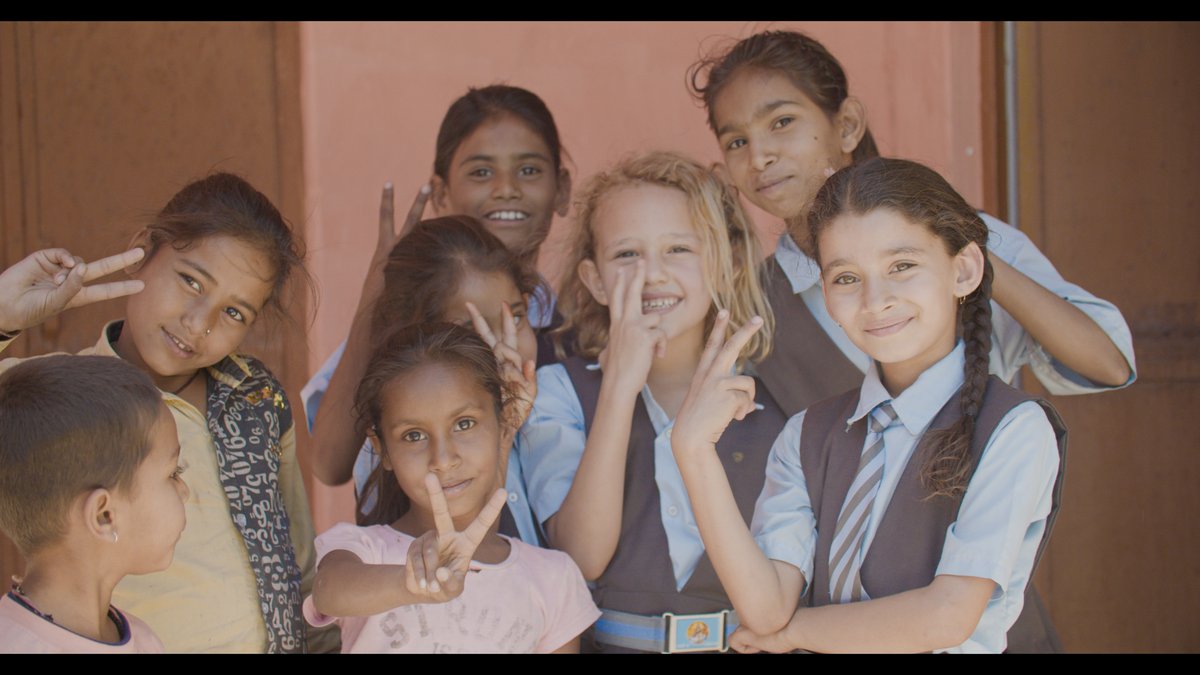
Emilia with her classmates — one month at a local school in India.
Roadschooling solves the screen time problem.
Worldschooling families notice this quickly: if you try to get children away from screens with rules and bans, it becomes a battle. You win sometimes. You lose other times. And every defeat costs energy.
But when real things compete with screens — things children can touch, smell, experience for themselves — screens lose automatically. Not through a rule. Through irrelevance.
The world out there solved this problem for us. Automatically.
How screens lost — the full story →The world starts at the end of your street.
You don't need a camper. You don't need a year off. Learning through travel works at any scale — a Saturday at the wholesale market, an afternoon watching the local carpenter, a train ride to the next town with a notebook and a question.
Every travel homeschool family we know started small. One trip. One encounter. One day where the child came home and you could see something had shifted. That's the whole method, scaled down. You don't need our route to use it.
Get the Practical Guide →Questions we get asked all the time.
After 10 years of travelling with children, these are the ones that come up at every campfire.
"But don't the kids have to go to school?"
This is the question we get asked most. Honest answer: in Germany, compulsory schooling applies. We don't offer legal advice — that's individual and the responsibility of each family.
What we can say: our daughters learn on the road. Intensively, daily, in ways no curriculum can map. Our daughters travel with an official written leave of absence from their school — the school actively supports the trip and stays in contact. What that means legally for your family, you need to work out for yourself.
The Screen Time Guide
Real family experience from 22 countries — adapted for everyday life anywhere.