"I missed my daughter's first crawl."
Travelling with kids — what families actually experience
Not the Instagram version. What actually happens when you set off with three children and the world becomes their classroom.
Why we chose this — Timo and Salima
I was a landscape gardener. Early starts, late finishes. When I finally got home in time to see Emilia crawl for the first time — I hadn't. Someone had sent me a video.
It wasn't missing the crawl that hit me. It was the video.
I asked Salima: what if we made a deliberate choice to live this time differently? Not as a holiday. As a real phase — with everything that comes with it, including the hard parts.
Salima didn't say yes straight away.
She asked: what does this mean for the children? What do they lose — school friends, routine, the familiar? And what does it mean for us as a family — two people who want to build something together, not just run alongside each other?
For Salima, it wasn't a sense of adventure that drove the decision. It was a growing conviction: that children learn more deeply in real situations than in any classroom. That encounters with unfamiliar people, languages and worlds awaken something in a child that no curriculum can plan for. That this time — if we took it now — would stay with them.
She said yes. With open eyes about what was coming.
In 2016 we left for the first time. Salima and I, Emilia in tow, no script. I had a camera — with no plan to use it.
Three years later we came home. With a cinema film.
Not because we were filmmakers. But because we'd started filming what we were living. Because on Bali, Elina was born — and we realised: this isn't just a journey anymore. This is the life we want to lead.
In 2022 we left again — two daughters this time, and the knowledge of what it means to be on the road. Through the Caucasus, Iran, India. In Goa, Enya was born. Three sisters, born on three continents.
Starting spring 2027, we're setting off for the third time. Salima and I. Emilia (10), Elina (6) and Enya (3). With an official school exemption — the school is actively involved. No return planned.
This isn't a holiday that got long. It's a way of life that revealed itself across two journeys — and continues into a third.
Who we are as a family →What has happened since.
Elina, Morocco
Elina learned her first Arabic word in Morocco. Not from a book. From a vegetable stall. She wanted a tomato and didn't know how to ask. She pointed. The woman laughed. Then together they found a word that worked. Elina came back and said it to us three times. Loud. She was proud in a way that no praise can replace.
The girls, India
In India the girls made roti. Over an open fire, because there was no electric stove. A family from the village had invited us in. The children watched, then joined in — pressing the dough, turning it, waiting. Emilia touched her first roti when it was too hot and still didn't let go. There was a lot of laughter. They ate together what the children had made themselves. It didn't taste particularly good. But it was theirs. The friendships from that evening have lasted.
Enya, the Sahara
In the Sahara, Enya noticed the silence. She was just past her third birthday. We'd stopped because I wanted to photograph something. Enya got out, looked up at the sky and simply stopped talking. For a long time. Then she said: "There's a lot up there." That was all. We didn't answer. There was nothing to add.
Emilia, Georgia
Since Georgia, Emilia carries the map. Not Google Maps — a real paper map that she folds and unfolds herself. She plans detours, estimates distances, sometimes gets it wrong and corrects herself without us saying a word. When we arrive where she was aiming for, she says nothing. She folds the map back up. That's enough for her.
Evenings in the camper
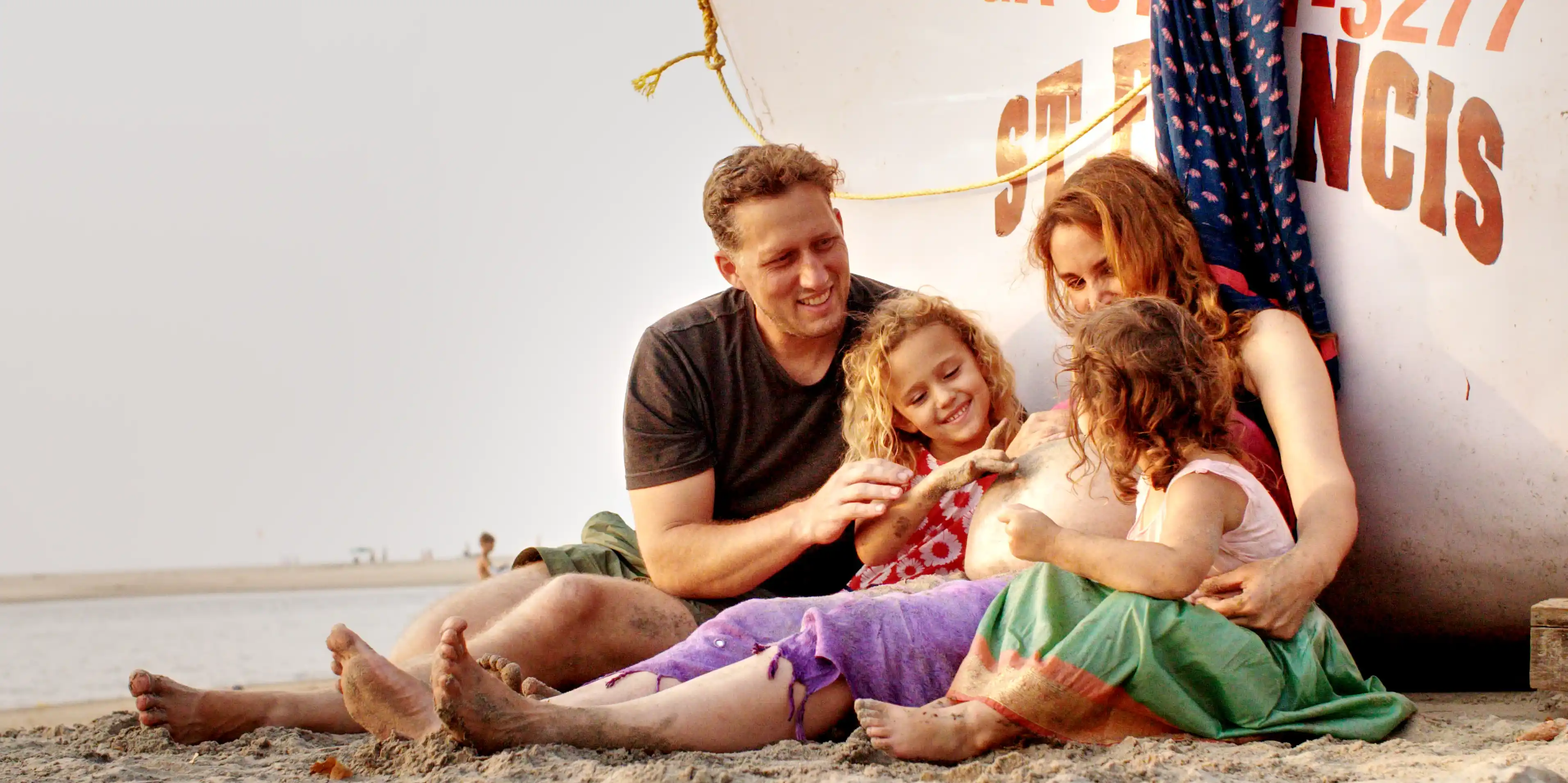
Three sisters in six square metres. It's not always harmonious. There are arguments about sleeping arrangements, volume, the last piece of something. But they resolve it. Every evening. Not because we step in — because they've learned they can. Nobody planned that. It just happened.
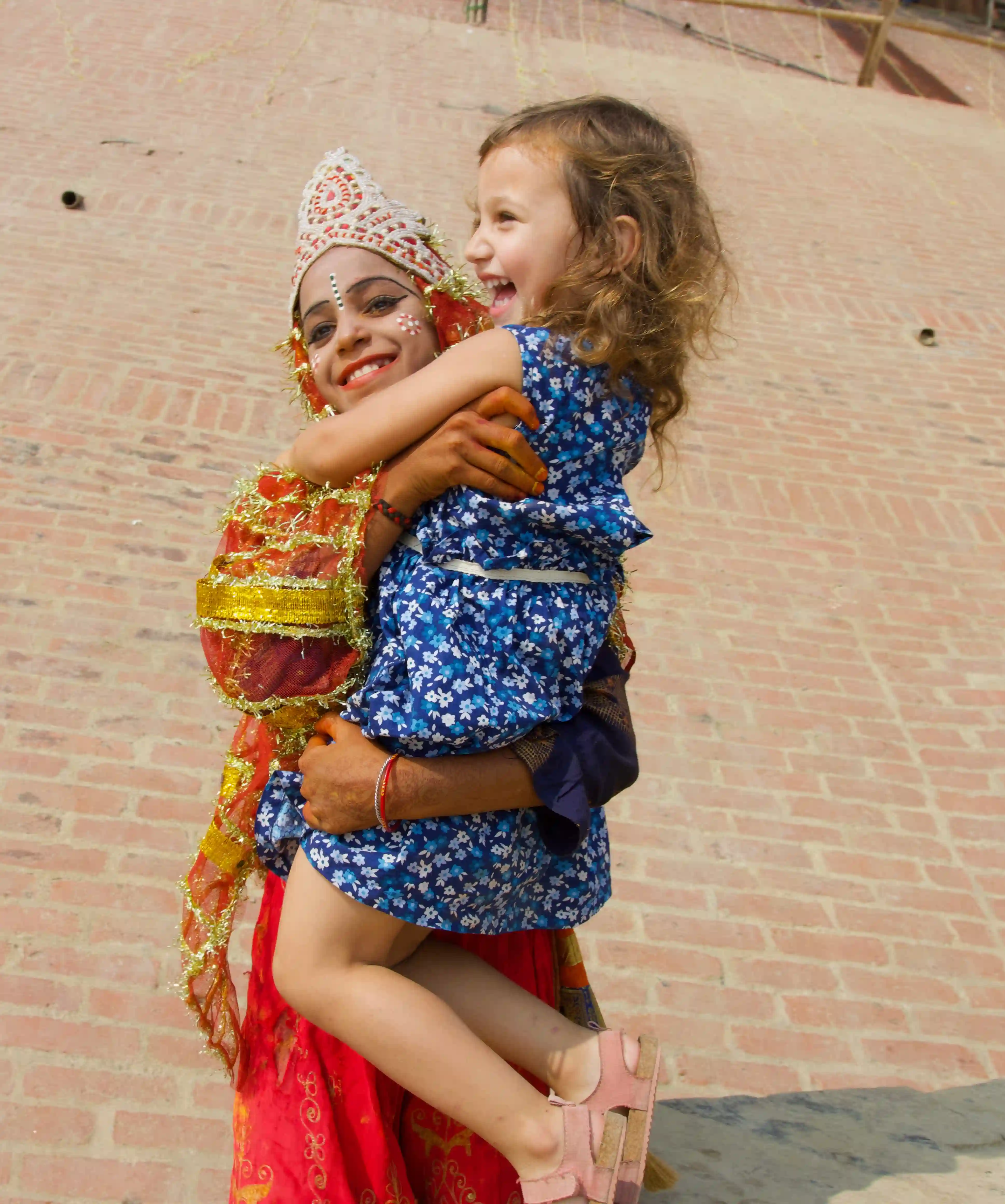
Encounters that stay. Moments no curriculum plans.
Emilia said goodbye to this woman without us saying a word. She simply turned around. And hugged her. In Rajasthan, India.
We're filmmakers. We watch a lot. But in that moment we were almost too slow to lift the camera — because we were too busy watching.
That's what travelling with children actually means — not the kilometres, not the list of countries. This one moment. This hug between two people who will never see each other again and both know: that was real.
We have 22 countries of these moments behind us. In each of them, something was woven into our daughters that is invisible but permanent.
Watch the Films — €14.90 each →Two journeys so far. A third begins in 2027. Three daughters born on three continents.
Germany → Balkans → Turkey → Georgia → Kazakhstan → Ladakh, India. On the road starting spring 2027. With an official school exemption and in active cooperation with the school. No return planned.
What children actually learn on the road — and what it means for every family
Roadschooling isn't an alternative to school. It's a different learning environment — connected to real life rather than a timetable. Our daughters have an official school exemption and the school is actively involved. What develops in this time can't be measured in grades — but it is observable.
After 22 countries our experiences come down to three areas. Each of them works without a world trip.
Languages emerge from necessity
Emilia speaks English because on the road she simply had no other option. Elina picks up Spanish from listening — she doesn't even call it learning. Enya repeats words in languages she doesn't know and asks what they mean with a persistence that surprises us. Language doesn't arise here as a school subject. It arises because you need it.
This works at home too: a film in the original language, a book without translation, a pen pal in another country. Language as a tool, not as a curriculum topic.
Confidence comes from real tasks
Emilia navigates. Elina does the shopping. Enya asks strangers — in her own way, with gestures and looks. Children who are given real tasks, with real consequences and no pre-planned rescue, learn to trust themselves. Not because someone tells them to. Because it happens.
This works at home too: a child who shops, cooks and decides for themselves — and lives with the consequences when something goes wrong.
Community is built through closeness and time
Three sisters in a camper isn't a harmony exercise. It's a real training ground — for compromise, for patience, for putting up with someone who's being difficult right now. You don't learn that in class. You learn it through real situations repeated every single day.
This works at home too: less retreating to separate rooms and screens. More cooking together, fixing things, planning things — time where people are actually present with each other.
We filmed this journey. Not as a documentary — as lived experience.
Salima and I are filmmakers. Everything we live through also becomes a film. No script, no staging. Only what actually happened — the quiet moments, the hard ones, the unexpected ones. Two films have been released. A third is in the works.
On the Way — When Encounters Change Everything
128 minutes · Theatrical documentary · 40+ cinemas
Three years in Asia. Sri Lanka, Thailand, Bali. A family learning to be at home everywhere and nowhere. This film doesn't show what people want to see — it shows what actually happens when encounters change you before you know they're doing it.
Watch On the Way — €14.90The Long Way Around
118 minutes · Theatrical documentary
Caucasus, Iran, India. Ten months held up by bureaucracy. A birth on the road. When the plan ends and life begins — and when the detour turns out to be the actual way.
Watch The Long Way Around — €14.9040+ cinemas. Coverage from ARD, SAT.1, SWR and Frankfurter Rundschau.
Our films weren't made for the internet. They ran on screen — in more than 40 cities, reviewed by media, watched by people who wrote letters afterwards. No branded production. No staged family portrait. Real people. Real moments.
The screen time problem solves itself on the road.
Before we left, screens were a daily battle. One hour? Two? When does the tablet go off? After we left, we stopped asking.
When children experience things that are genuinely interesting — a net full of fish, a market that smells of spices, a friend who speaks a language they don't know — screens can't compete. They lose automatically.
We wrote down exactly how that works — and how you can apply the principle at home without a camper.
The Screen Time Guide →You don't have to leave.
What we've learned on this journey about children, learning, screens and real experience — it translates to any everyday life. No camper needed. No school exemption.
For parents who are staying home and still want to change something:
Download the Guide — €14.90 →