What Children Really Need — That No Screen Can Give Them
After two journeys across 22 countries — with three daughters, aged 3, 6, and 10 — we think we have an answer.
What children need that no screen can give.
Real Experiences
Children need to touch, smell, taste, hear, and see the world for themselves. A video of a rainforest is not a rainforest. A real market smells. That's the difference.
Unstructured Time
Boredom is not an enemy. It's the starting point of every good idea. Children who are never bored never learn to fill their own time.
Present Parents
Not perfect parents. Not always-happy parents. Present ones. Children feel the difference between a parent who is there and one who is physically in the same room.
Real Relationships
Friendships built over time. Neighbours. Cousins. People who know them, not just follow them. The number of followers doesn't replace a single real friend.
Stories
Books, not just algorithms. Stories that end. Characters who struggle and fail. Children need narratives that don't always resolve in the next five minutes.
Nature
Not as a concept. As a place. Mud. Sticks. Cold water. Something that resists. Something children can't swipe away.
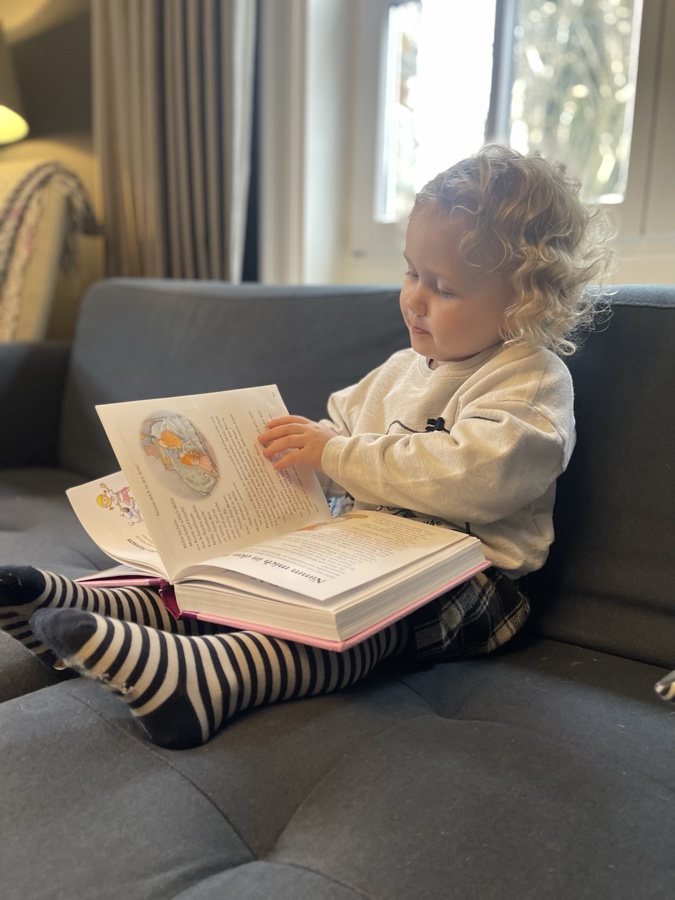
Nobody told Enya to pick up that book.
She's three. The sofa was empty. There was no screen in the room. She walked over, sat down, opened the book — and stayed there for forty minutes.
We didn't teach her to do that. We just stopped getting in the way. When our daughters are fully in the real world — building something, talking to a stranger in a language they barely speak, exploring what lives under a stone — they forget entirely that a phone exists. Not they don't mention it. They forget.
We call this the Forgetting Effect. It only shows up under one condition — and that condition is what the guide explains.
A full child doesn't ask for the screen. A full child doesn't need to be told no. A full child is already somewhere else.
Get the Guide — $14.90 →We live in an age where children's attention has become a commodity. Every app, every platform, every device is designed to hold it for as long as possible.
But attention is not infinite. What goes into the screen doesn't go into the world.
We don't believe in banning technology. We believe in understanding what replaces it when it's gone.
On our journeys — through Sri Lanka, India, the Caucasus — we've watched our three daughters encounter the world. The fascination wasn't in any app. It was in a fisherman's net. In a language they didn't speak. In a child from another culture who wanted to play.
That's what children really need. And the good news: you don't need a camper to give it to them.
The problem isn't your child. It's who built the app.
There are people whose entire job is to study how a child's brain responds to reward — then design apps around what they find. They are very good at it. Their salary depends on it.
The app has points. The points unlock a game. The game opens another level. Every twenty seconds, a small reward. Your child's brain learns that rhythm in a single afternoon — and starts expecting the next hit even when the screen is off.
This is not your child being weak. This is a team of behavioural scientists going up against a six-year-old and a tired adult at the end of a long day. It was never a fair fight.
So we stopped trying to win that fight. We changed the question — from how do I get her off the phone to what can I put in front of her that's more interesting than the phone.
“The goal was never a child who is forbidden from screens. The goal is a child who finds the world more interesting.”
We document it all — live, on the road.
Everything we observe, learn, and try with our three daughters — straight from the camper. No performance, no highlight reel.
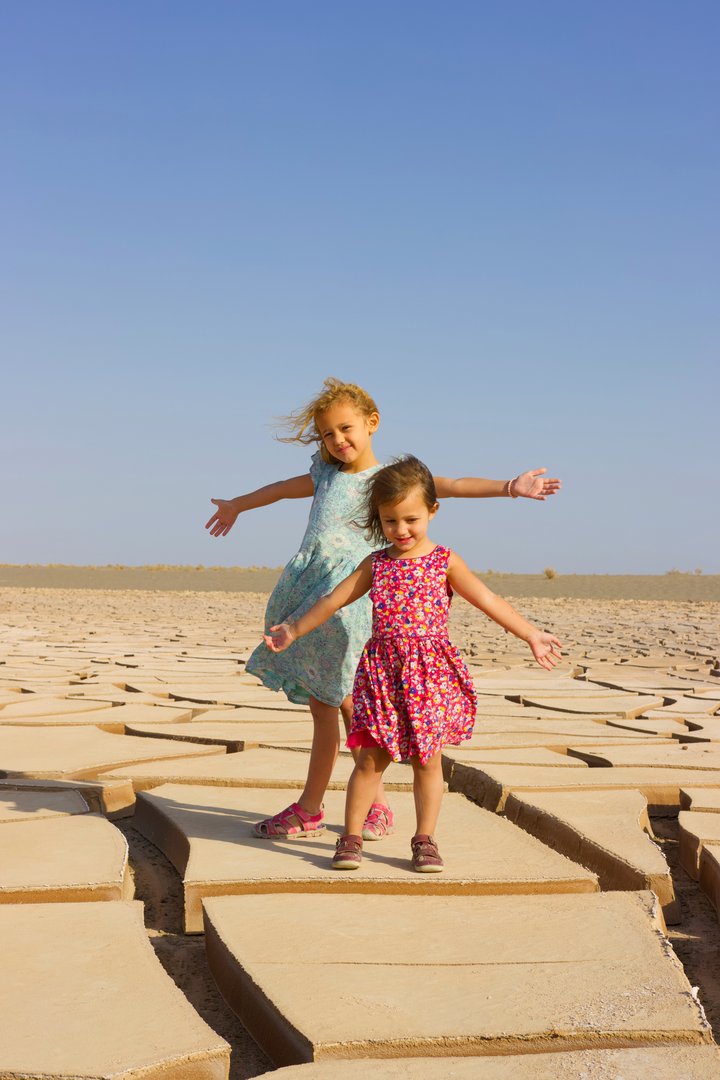
No toy. No app. Just a cracked desert floor and each other.
We pulled over somewhere in the Sahara. The girls got out. Within thirty seconds they had invented a game involving the cracked earth and absolutely nothing else.
They played for two hours. Nobody asked for a phone.
That's not parenting wisdom. That's just what happens when you give children enough space.
You don't need 22 countries. You need the decision.
A few years ago we parked in the middle of nowhere in Spain. Our daughters climbed out and within an hour had built a small garden — stones in a border, wild plants replanted, a stick for a sign. We drove away the next morning.
Four months later we came back to that exact spot. The garden was still there. Overgrown, changed by weather. Still theirs. The girls stood around it like scientists examining something rare.
They didn't need Spain for that. They needed a patch of dirt and an adult who didn't hand them a phone.
A pot on a balcony works. The corner of a backyard works. The patch of weeds next to a car park works. Children don't need the world to be large. They need it to be real.
We wrote 47 pages about exactly this. Twelve things that work in an apartment, not just a camper. Built from what actually happened in our family — not from theory.